Rethinking Lead Intake for a Dutch Matchmaking Practice
Replacing early-2000s software with Zoho CRM for a Dutch matchmaking practice
The following case study follows a CRM migration and lead-system rebuild for Mens en Relatie (M&R), a Dutch matchmaking company — from first contact with the client to a live system that now moves a lead from form submission to the right matchmaker's phone in under two minutes, down from over two hours. I was invited onto the project by the CEO as a freelance consultant, working from their office every Friday for six months.
M&R runs a network of 33 matchmakers across the Netherlands, processing every lead through custom software built in the early 2000s. The success of this project hinged on replacing that old system faithfully — losing none of the leads it captured — while laying the foundation for a modern database that could bring better features, real integrations, and room to grow.
By the end, the team had all the perks that come with a modern system: full transparency over their data, ten automated workflows running the operation behind the scenes, and a core lead-intake engine that screens each submission against the blacklist, deduplicates incoming leads, assigns every one to the right matchmaker by postcode, and more.
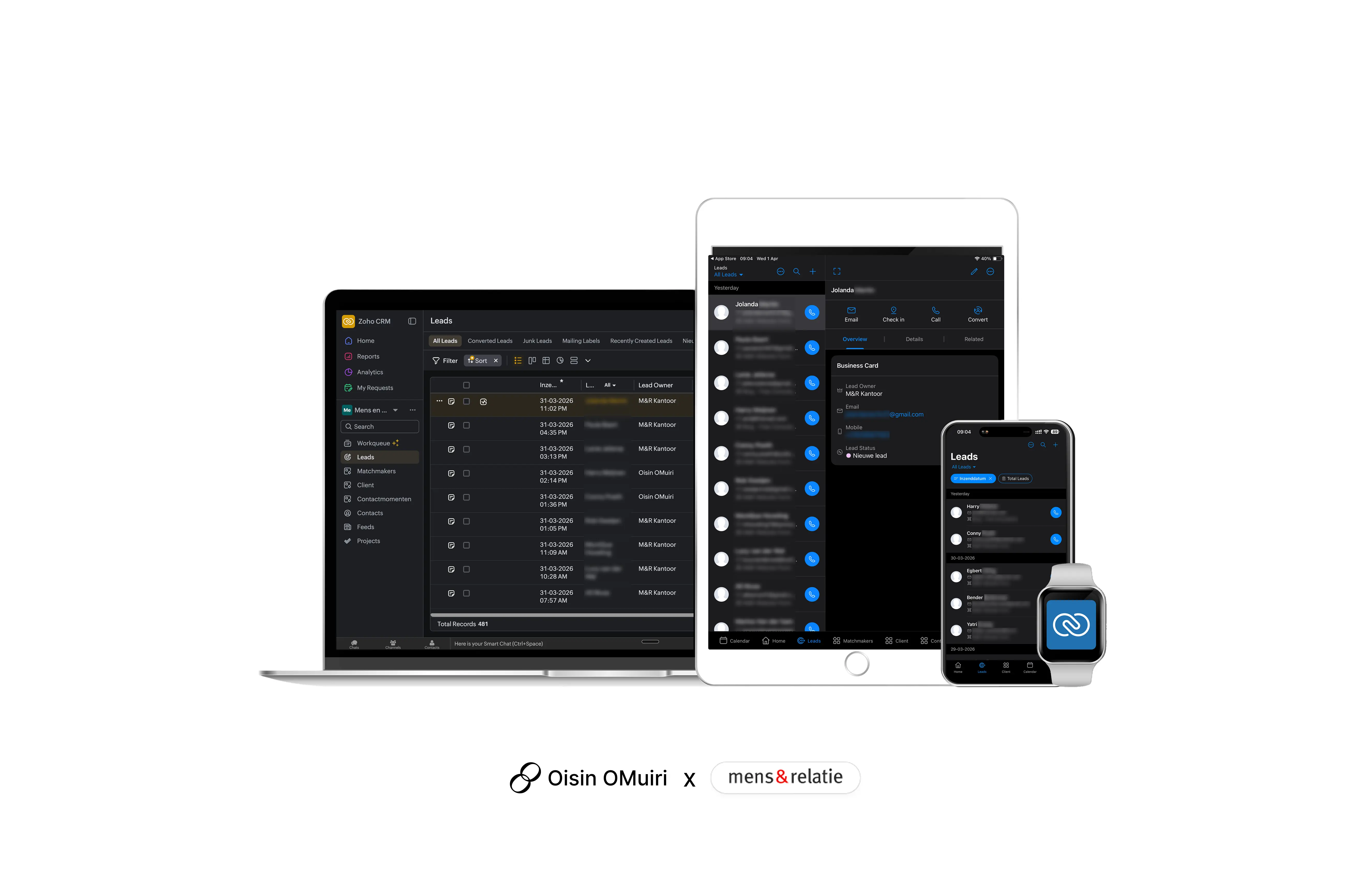
From over two hours to under two minutes — every lead now lands clean in Zoho and pings the right matchmaker’s phone.
Leads Went Cold in the Silence
Mens en Relatie serves adults looking for a partner. At its core is a ten-person team coordinating a network of 33 matchmakers spread across the Netherlands, who meet with leads, convert them into clients, and craft each client's profile for matching. It's a bespoke service — one that takes the time to understand a client and connect them with a quality match — and it has the record to show for it: a 75% success rate and 65,000 matches confirmed over 40 years.
Every morning, a matchmaker would log into the lead system, look at the leads assigned to them, and start making calls. But hours — sometimes days — could pass between a prospect submitting their interest and that first call, and in that window a lead goes cold: they may register with a competing service, or lose the interest that made them reach out at all. Nothing notified the matchmaker of a new lead — they only discovered one by logging in and checking for themselves.
Therefore the brief was to integrate Zoho CRM and set up its mobile app so matchmakers receive notifications of incoming leads. The foundation was to be set for a stronger database, integrated with existing softwares, and automated where possible. This was to be achieved while capturing every lead the old system did.
Mapping the Whole Business First
I ran a series of workshops with the CEO and used the material to build a Business Process Map of the entire practice in Lucidchart (BPMN 2.0). The map covered four areas: leads, onboarding, matchmaking, and the internal mechanism for capturing and leveraging the leads already in the system.
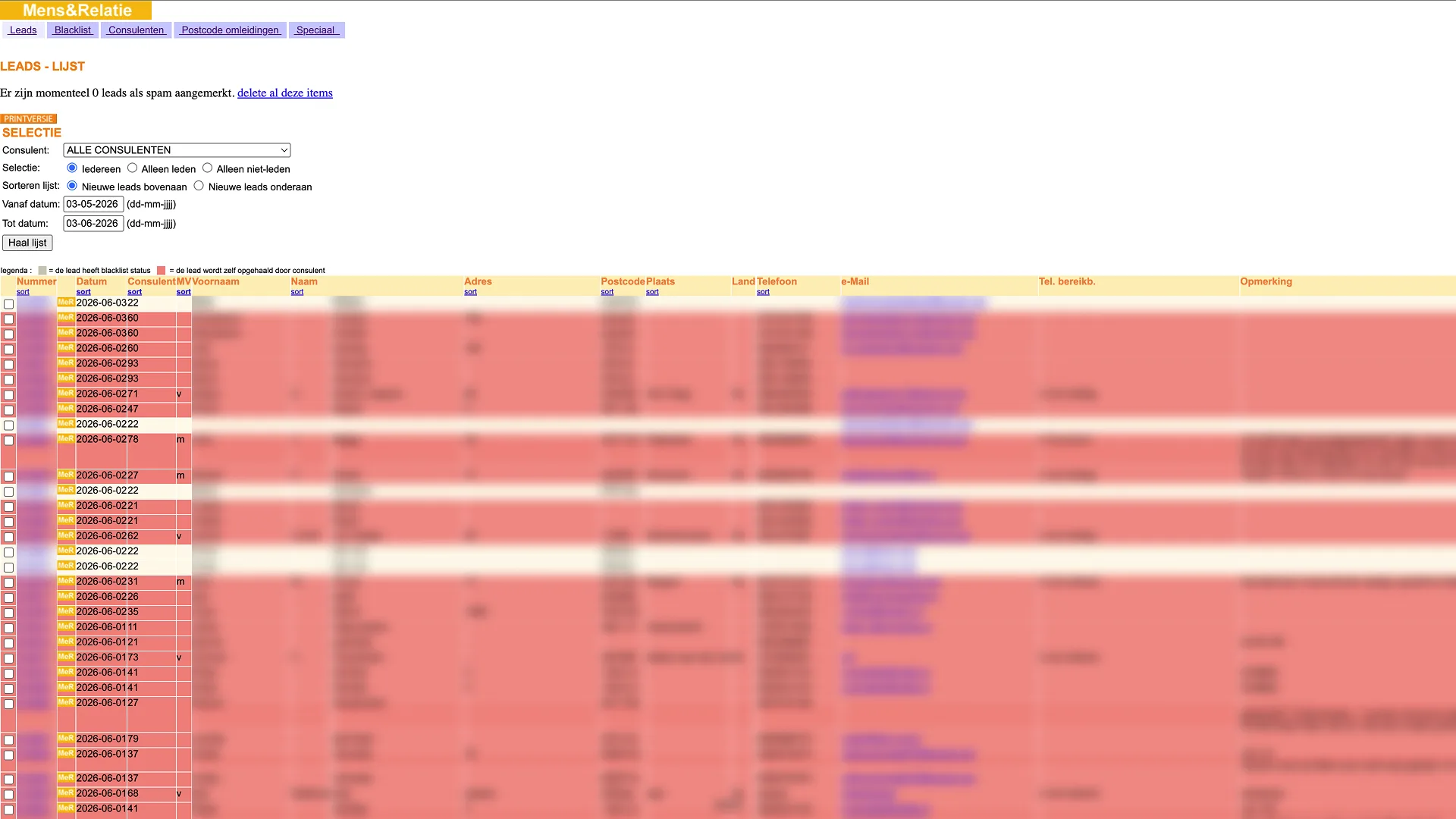
The map was the unlock. Once the full operation was drawn, the new intake had something concrete to mirror — and the gaps the rebuild needed to close became visible: no notifications, no deduplication, and a hard-to-use legacy UI.
Process Maps In, Working Automations Out
I designed the new system around a single principle: every lead becomes one clean record the moment it arrives, and the matchmaker hears about it on their phone — not the next time they remember to log in.
A unified intake layer in n8n captures the form, deduplicates, writes a clean record into Zoho CRM, and pushes a notification to the assigned matchmaker. Migrating the CRM to Zoho gave the team a tool that fits how a modern practice actually works.
The workflows were built with Claude Code driving the n8n MCP server. The loop: load the BPMN map, CRM schema, business rules, and edge cases into a Claude Code agent as context; talk through intent and constraints — what must happen, what must not, where the human stays in the loop; outline triggers, branches, error paths, and retry logic; plan the data model and where deduplication happens; let Claude generate the n8n workflow JSON via the MCP and print it straight into n8n; then validate, import, smoke-test, and iterate.
The skill lives in structuring the agent's context well enough that the generation comes out accurate, then iterating against a live n8n instance through the MCP.
Four Decisions That Shaped the System
Phone notifications, not manual checks.
The matchmaker hears about a new lead within minutes, on the device they actually carry. The old behaviour — log in periodically and hope something is there — is gone.
Deduplicate at intake, not in cleanup.
The same prospect submitting the form three times produces one record, not three. Matchmakers stopped deciphering duplicates because no duplicates reach them.
Single source of truth in Zoho.
A matchmaker opening a record sees the same picture every other matchmaker sees. The legacy system is no longer load-bearing.
Auditable transparency by design.
n8n's execution log shows every step, every API call, every transformation for every lead. When someone asks "what happened to this person," the answer is one click away.
From Over Two Hours to Under Two Minutes
The system is live in testing and being used daily. Two measurable outcomes already stand out.
From over two hours to under two minutes. Before the rebuild, a prospect submitting the intake form waited more than two hours before the lead even arrived in the system the matchmakers worked from. In the new system, the same journey — form submission to lead appearing in front of the right matchmaker — completes in under two minutes.
Duplicate-sifting time, essentially eliminated. The old intake had no deduplication, and matchmakers spent time working out which of several entries was real. The new intake deduplicates at capture, and that lost time is gone.
I'm being careful not to claim conversion lift or revenue impact yet — the rollout is still in progress. But the two time-based outcomes are measurable, consistent, and directly attributable to the new intake.